Life, trade with Punt, Deir el-Bahari’s terraces, divine birth colonnade, Anubis chapel, Punt reliefs—and how to visit with Expedition Egypt.
Hatshepsut ranks among Egypt’s most successful pharaohs—and among the first women rulers whose deeds survive in detail. Daughter of Thutmose I and Ahmose, she married her half-brother Thutmose II and later ruled as king in the 18th Dynasty New Kingdom, with regnal dates often cited around 1478–1458 BCE (debated).
Meaning of Her Names
Her personal name suggests “foremost of noble women”; her throne name Maatkare evokes truth and the ka of Re. She expanded trade, especially the famous expedition to Punt, recorded on her mortuary temple walls—bringing incense, ivory, and exotic goods that advertised divine favor and prosperity.
Building Legacy
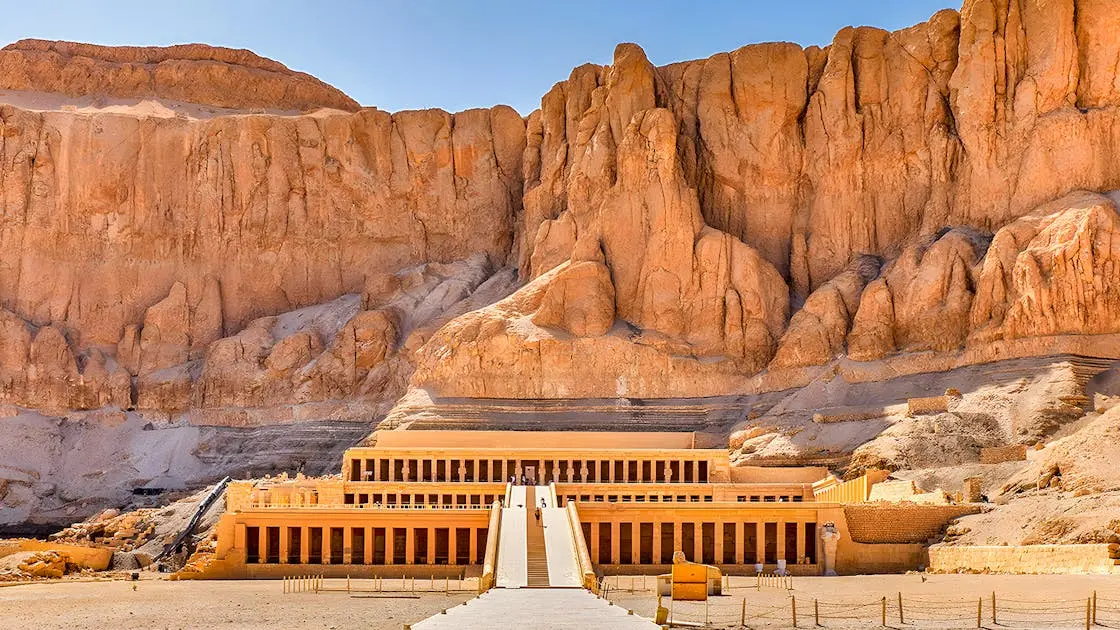
Her greatest monument is the terraced mortuary temple at Deir el-Bahari on Luxor’s west bank—Senenmut’s design tiers against the cliffs, merging with the landscape. She erected works from the Delta to Nubia; statuary carried her image as both woman and king.
Identification of Her Mummy
In 2007, a mummy from KV60 was linked to Hatshepsut when a tooth in a labeled box matched a socket in the jaw—she may have died around fifty, with evidence of diabetes; nail polish and posthumous damage to her monuments reflect later politics as much as health.
Deir el-Bahari: Site and Symbolism
The modern name refers to a Coptic monastery; anciently the place was sacred—“holy of holies.” The temple honored Amun and served as her mortuary cult; chapels also celebrated Anubis, Hathor, and her claimed divine birth—propaganda legitimizing female kingship, much as Amenhotep III later echoed at Luxor Temple.
Damage and Restoration
After her death, Thutmose III systematically erased many of her images—family politics, not mere vandalism. Akhenaten’s followers attacked Amun’s name; Ramesses II attempted repairs—visible in uneven restoration quality.
Visitor’s Path Through the Temple
A vanished sphinx avenue once climbed from the valley. The lower court may have held gardens evoking Punt. Colonnades rise toward ramps; the birth colonnade narrates Amun and Ahmose conceiving the queen; the Punt colonnade depicts ships, the chief of Punt, and his famously depicted wife—unique documentary art.
The Chapel of Anubis preserves vivid painted ritual scenes; upper terraces culminate in the sanctuary—architecture still compared to later classical ideals.
See Hatshepsut’s world with Expedition Egypt: west-bank Luxor days pair her temple with the Valley of the Kings, balloon options, and Nile extensions to Aswan.