According to the official history of a 3rd-century BC priest, a king named Menes united the various kingdoms of the Nile Valley for the first time under one government around 3100 BC, beginning what archaeologists refer to as the Early Dynastic Period (3050–2686 BC).
The reliability of this version of history is questionable, but it is generally accepted that several civilizations that had lived and practiced agriculture along the river since the sixth millennium BC were united at this time under the influence of the capital at Memphis. Several centuries later, the strength of this central control and the influence that Memphis held over trade routes to the south and northeast to the Levant led to the beginning of the Old Kingdom (2686–2181 BC).
This development was the beginning of nearly three thousand years of history during which thirty successive dynasties would control the Nile Valley, but not always from Memphis.
The power centered on Memphis eventually waned, fractured, and then was reestablished again to begin the Middle Kingdom (2134–1690 BC), when power was based at a capital near modern-day Fayoum. The third period of strong central control, known as the New Kingdom (1549–1069 BC), was centered on the southern capital of Thebes.
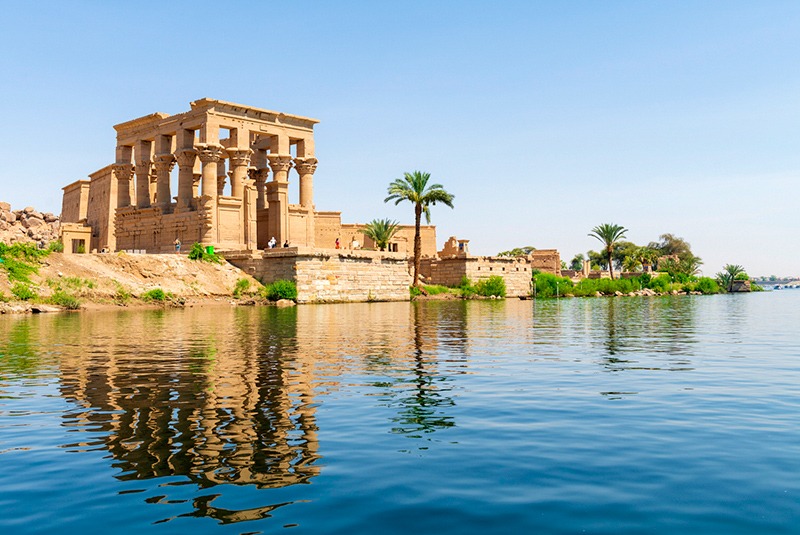
Today we still admire the monuments that these great kingdoms constructed. The pyramids near Cairo and many monuments in and around modern Luxor (ancient Thebes) stand out as wonders of the ancient world. These most famous ancient sites were the grand burial sites of the pharaohs that built and rebuilt ancient Egypt under their control over the centuries, but the architectural legacy of this powerful civilization was not limited to these sites alone. There were other important cities and religious sites scattered up and down the Nile Valley where the monuments of the pharaohs and great temples of the ancient religion were built, and where impressive ruins can still be viewed today.
The Nile Valley beyond Cairo and Luxor
Although they are further from the population centers of Cairo and Luxor, these sites are no less impressive or important to the history of ancient Egypt than the more famous places at Giza, Karnak, and Luxor and the Valley of the Kings.
They mark the locations of other ancient capitals from which pharaohs once ruled the entire region and the sites of religious cults where the gods of ancient Egypt were worshipped from the Early Dynastic Period into the first centuries AD, when Christianity gradually replaced the ancient religion as the popular faith of Egypt.
Karnak
Karnak temple is divided into three compounds: the precinct of Amun, the precinct of Mut, and the precinct of Montu. For most visitors, the precinct of Amun is enough, as it is the largest of these three. The temple’s complicated layout alone dwarfs almost every other site you will visit in Egypt—it is an enormous ancient temple complex.
The precinct of Amun contains the most famous sections of Karnak, including the dizzying Great Hypostyle Hall. This hall of 134 massive columns is one of the most impressive spaces in all of Egypt. A full description of every element of the complex could go on almost without end.
Like many major sights in Egypt, especially the Giza pyramids, Karnak offers a sound-and-light show in several languages. The show runs three times a night; check with your tour guide or hotel for the schedule and language of each performance.
Luxor
This city has been nicknamed “the world’s greatest open-air museum,” thanks to the ancient pharaohs’ efforts to immortalize themselves. They raised enormous buildings to display power and authority. Both sides of the Nile are covered with the remains of temples and funerary complexes. The modern city grew up beside these ruins, creating a mix of old and new found almost nowhere else. This is most evident around Luxor Temple and the Karnak complex, where ancient stone architecture meets sleek modern construction.
The area around Luxor and the west bank are dotted with many other temples and tombs. It would take several days to explore all of the archaeological sites in the region. Each site holds a wealth of knowledge about ancient Egyptian life and heritage.
The Valley of the Kings
On the west bank of the Nile near Luxor lies the Valley of the Kings—the most famous cluster of royal tombs and breathtaking ancient work in Upper Egypt. That concentration makes it a focal point for anyone exploring pharaonic history. Archaeologists have surveyed the valley for centuries, and it continues to yield surprises.
The richness of the finds here has kept archaeologists busy for nearly two centuries. If every tomb were open to visitors, touring them all would be almost impossible—fortunately only a rotating selection is accessible at any one time, which makes a meaningful visit manageable.
Egypt tours and trips
Ancient wonders. Hidden treasures. Endless seas and golden sand. Make lifelong memories on our Egypt tours.
Once a land of dynasties and decadence; now a land where history feels within reach. Our Egypt journeys place you in the shadows of the past—at the foot of the Great Pyramids, in the heart of the tomb-strewn Valley of the Kings, or before the mighty temples of Abu Simbel.
That is not all: our tours to Egypt aim to offer what money cannot buy on its own—once-in-a-lifetime moments, rare experiences, and lasting friendships with fellow travelers.